
Today was a long day, but compared with last week, it was a very good one.
I was up before 7:00 this morning and arrived at the hospital around 8:15. The day started with blood work and then a 9:00 echocardiogram, one of the tests required as part of the continuing evaluation for a possible stem cell transplant. They used contrast during the echo to get a clearer look at my heart.
And this time I didn’t have to wait days for an answer.
By the time I saw my medical team later in the day, they had already reviewed the results. The PA told me the echo looked normal, with good pumping function on both the right and left sides, good-looking valves and nothing that appeared worrisome.
Then my doctor came in and was even more direct.
She called the echocardiogram “perfect” and said, “Your heart’s working fine.”
That was particularly reassuring after all the concern about my heart rate, EKG and the fluid weight I gained during last week’s hospitalization. She explained that the heart-related blood tests they had checked when I became dizzy were also fine. The BNP—the test that had become elevated when I was carrying all that extra fluid—had come back down to around 50 as the fluid came off.
Most reassuring of all, she said plainly: “You do not have heart failure.”
She also confirmed that the EKG changes that had caused some concern during the hospital stay were old changes, not something new.
I completed pulmonary testing as well. I was told I did “excellent,” and my medical team later confirmed that the pulmonary results were normal.
So, as far as these two major transplant screening tests are concerned, today brought very good news.
We also talked about the remarkable change in my blood after the first MOGA treatment. My lymphocyte count had fallen by roughly 97 percent. My doctor used a memorable expression to describe what had happened—a “blood bomb”, similar to the kind of dramatic blood response she sometimes sees in leukemia patients.
She explained that in leukemia, doctors sometimes see tumor lysis syndrome, where large numbers of cells are destroyed rapidly and create a major reaction. MOGA normally doesn’t act like traditional chemotherapy, but she said they have occasionally seen something similar with it. In my case, she described what happened as a very strong reaction in my lymphocytes.
She also made an encouraging prediction about me: because I seem to be such a strong immunologic responder, she thought there was reason to hope that the disease would respond strongly as well.
Of course, a 97 percent reduction in lymphocytes does not mean that 97 percent of my cancer is gone. Sézary syndrome involves more than just the blood. We still need to see what happens in the skin, lymph nodes and subcutaneous areas, and future flow cytometry and imaging will tell us much more.
But after everything that happened following the first infusion, hearing my doctor characterize the blood response as that dramatic was certainly encouraging.
There was a delay getting today’s MOGA from the pharmacy, but once the infusion began, things were almost remarkably uneventful.
That is a word I am very happy to use.
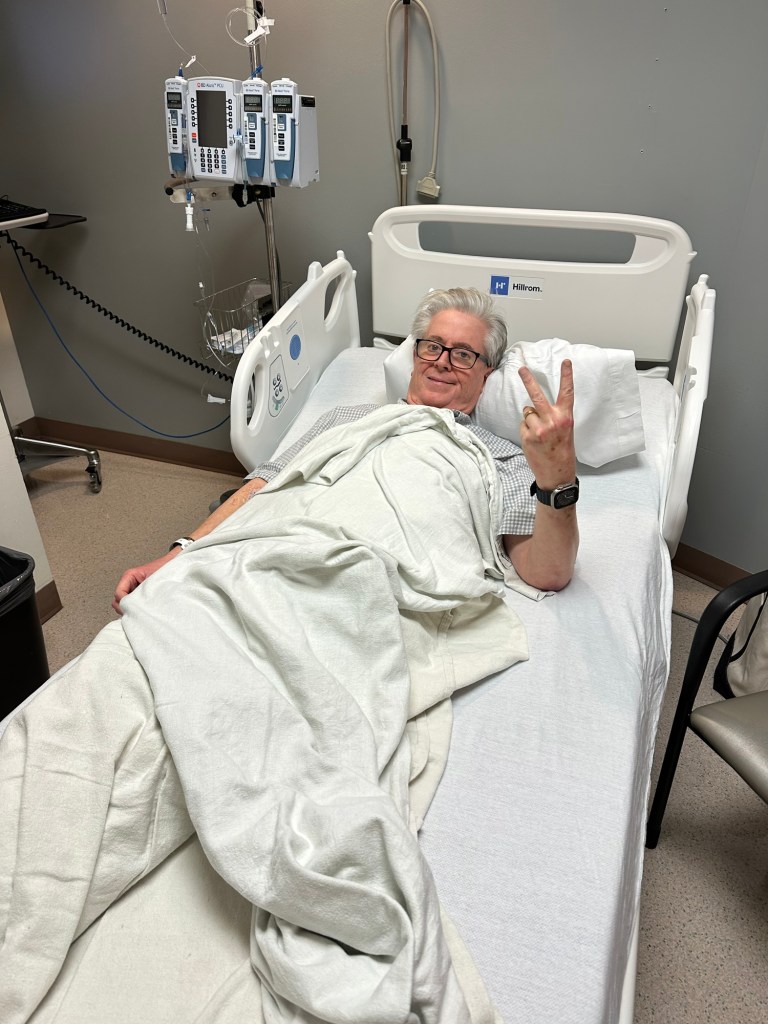
The premedications and infusion procedure were essentially the same as last time. This time there was no flushing, dizziness, fever or other obvious infusion reaction.
Afterward I stayed for the required one-hour monitoring period. Nothing happened there either.
My systolic blood pressure—the upper number—reached 133 at one point, which is higher than normal for me. Considering how apprehensive I was about repeating an infusion after last week’s experience, anxiety seems like a very plausible contributor.
Then they let me go home.
The ride home was completely uneventful as well.
And now I am back where I wanted to be. The dogs have been fed. I’m sitting at home with a non-alcoholic beer, watching the news on television, with meatballs and mashed potatoes generously provided by my niece waiting for dinner.
It is tempting to declare today’s second MOGA treatment a complete success, but I’m not quite ready to do that yet.
Last week, I made it through the first infusion and went home. The more severe part of the reaction—the fever and illness that eventually sent me back to the hospital—didn’t develop until the following day. So while I am enormously relieved that today’s infusion and monitoring period were uneventful, I would still like to get through tomorrow before I feel completely comfortable saying that treatment number two was different.
For tonight, though, the contrast is striking.
I’m home. I feel okay. The dogs are fed. Dinner is waiting.
After last week, that’s more than enough good news for one day.

