
September 8, 2026
Today was mogamulizumab infusion number four.
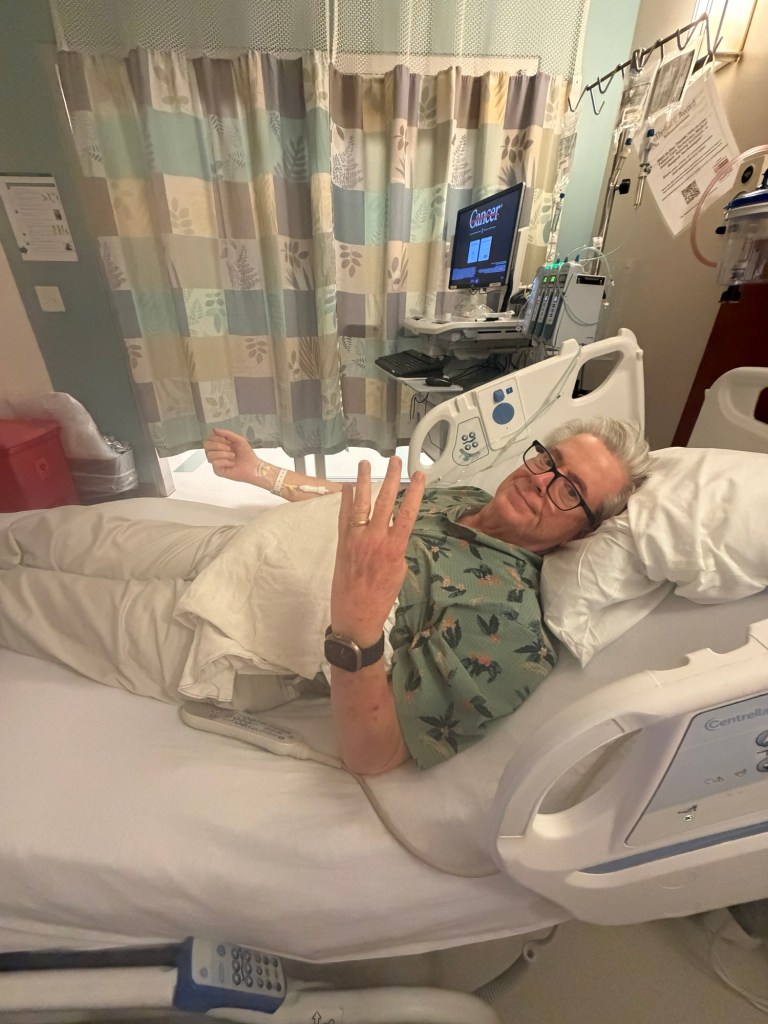
And for the first time since this whole process began, I walked into treatment with something more than hope that the drug was working. We now have some pretty remarkable evidence.
My latest flow cytometry—the test that actually looks at the abnormal T-cells circulating in my blood—showed that the cancer cells in my blood are now almost gone.
After only two infusions.
When the result first appeared, I looked at the numbers myself and thought they were extraordinary. I sent a message asking whether I was reading them correctly. The response from my team was essentially: yes, you are. The flow cytometry looks much better. This is great.
Considering where we started—with substantial Sézary cells circulating in my blood—the fact that MOGA has reduced them so dramatically and so quickly is about as encouraging a treatment response as I could have hoped for.
The visible evidence is almost as striking.
My skin looks dramatically better. Most of the widespread redness and rash that covered so much of my body before treatment has disappeared. Normal-looking skin has returned over large areas. My doctor looked at me today and said, simply:
“You look so much better.”
She was right.
There are still a few odd spots. I have some circular areas on my abdomen that I had assumed were fungal because steroid cream seemed to make them worse and antifungal cream seemed to improve them. My doctor isn’t convinced they are fungal at all.
Then Andrea discovered something completely new while we were waiting for the doctors—a bright red raised bump on my back that neither of us had noticed before.
Fortunately, it looked like it may simply be a bug bite, complete with a tiny puncture point in the center. We had been at the farm over the weekend, so that theory certainly fits.
They photographed it. I’m supposed to use topical steroid and watch it. If it doesn’t go away, they’ll biopsy it.
There was another encouraging physical finding today. Last week there had been some concern about an area in my neck that felt unusually firm. Today it seemed softer and less stiff. Nobody could feel the small nodule we had discussed before.
That raises the question I keep asking: we can see that the treatment is working spectacularly well in my blood and skin—but is it also reaching the lymphoma in the lymph nodes and deeper tissue?
The answer today was:
Probably.
We won’t really know until the follow-up testing, particularly the PET scan, but the signs so far are encouraging.
My laboratory results were also good enough that there was no concern about proceeding with treatment. My white blood cell count remains low, but my neutrophil count was 2.23, still in the normal range.
I also asked about a guys’ trip to Aspen with my Breakfast Club that is planned for early October. I wanted to know whether flying and being around people should concern me while I’m on treatment.
The explanation was reassuring. MOGA changes the immune system, but I am not currently neutropenic. The important thing is that if I do get sick, I shouldn’t sit around for several days hoping it will resolve on its own. My medical team wants a lower threshold for evaluating and treating infections while I’m on MOGA.
So for now, Aspen is still on the calendar.
There is one side effect we are watching more closely now.
Apparently, if I’m going to write honestly about cancer treatment, I don’t get to share only the impressive blood-test results. I also have to report the less glamorous details of how often I’m going to the bathroom. So here we go.
I have continued to have diarrhea two or three times a day. I had blamed it on stool softeners, but I stopped those about ten days ago and the diarrhea has continued. Diarrhea is also a known side effect of MOGA, so we are watching it more carefully.
For now, they are comfortable watching it. But if it increases to around four times a day and stays there, I’m supposed to call rather than waiting for my next appointment because MOGA can sometimes cause inflammation of the colon.
One of the nicest parts of the day was lunch with an old fraternity brother who has been in Houston from Los Angeles for treatment for more than a year. It was good to sit together in the middle of a hospital day and simply catch up as old friends.
Otherwise, I feel surprisingly good.
A little tired, perhaps—maybe ten percent below normal—but no fever, chills, night sweats, or reaction to the last infusion.
My mood is good too.
So today we proceeded with infusion number four.
Next week is number five.
After that, assuming everything continues to go well, the weekly treatments end and MOGA moves to every other week.
There is still a long road in front of us. We still have to find out how completely the disease is responding outside the bloodstream. The transplant question hasn’t gone away.
But today deserves to be recognized for what it was.
A few weeks ago, approximately 90% of the T-cells circulating in my blood were malignant Sézary cells.
Now, after only a handful of treatments, those cancer cells are almost gone from my blood, my skin looks remarkably better, and even my doctors seem genuinely impressed by how quickly I have responded.
I have learned not to get too far ahead of myself with this disease.
But when there is good news, it is okay to stop for a moment and appreciate it.
Today was good news.

