
October 20, 2026
In my September 29 update, Marching Firmly in the Right Direction, my oncologist had described the improvement in my skin as “night and day,” and I was feeling pretty good about the progress we were making.
Well, apparently the road to remission has a few potholes.
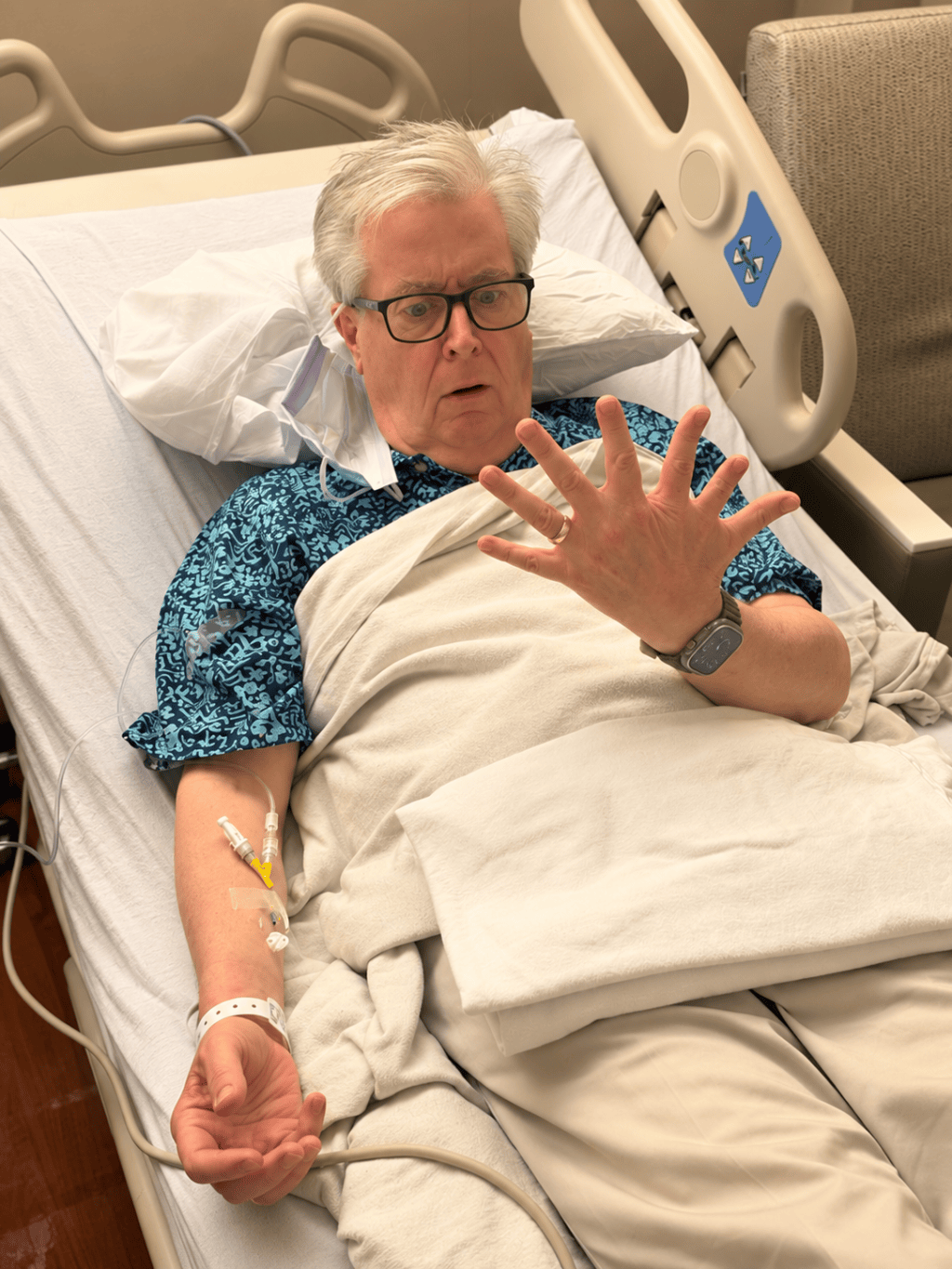
Last week, I missed my scheduled mogamulizumab (MOGA) infusion for the first time. I had been feeling unusually tired and generally lousy, and an ear thermometer suggested I had a fever of about 101 degrees. That sent me to the emergency room for evaluation.
By the time I got there, my temperature was normal, and testing didn’t identify an obvious infection.
There’s another possible explanation for some of my exhaustion. I had just returned from a trip to Aspen, where I managed to accumulate an astonishing 740% of my normal weekly exercise. That is not a typo. Apparently, when you take a 69-year-old cancer patient from Houston to the mountains of Colorado, he occasionally forgets he’s not 35 anymore.
My oncologist thinks the extraordinary physical exertion, combined with the inflammation it can produce, may have contributed to how I was feeling. She also explained that MOGA affects the immune system in some unusual ways. Giving another infusion when my body was already under stress might have created additional problems.
So, skipping the treatment was the prudent decision.
Unfortunately, something else happened.
My rash came back.
After several weeks of remarkable improvement, the redness and itching began returning, especially on my back and abdomen. It wasn’t nearly as bad as it was before treatment began, but it was enough to get my attention.
And my doctors’ attention, too.
At today’s appointment, we discussed whether this was my Sézary syndrome becoming active again, a reaction to the MOGA itself, or simply my skin responding to the inflammation my body had been experiencing.
The frustrating answer is that nobody knows for certain.
MOGA can cause a rash that looks remarkably similar to Sézary syndrome. But my oncologist pointed out that the returning rash follows much the same pattern as my original disease. That makes her suspect it may be the Sézary rather than a drug reaction.
She was also candid about something that concerned her: the possibility that missing even one treatment allowed some of the disease activity to reappear.
She emphasized that we’re still early in treatment, that I am not yet in complete remission, and that a flare after a missed dose is not necessarily unexpected.
Still, it wasn’t what any of us wanted to see.
Then we had a particularly interesting conversation about stem cell transplantation.
Until recently, my understanding had been that the goal was to achieve remission with MOGA and then move toward an allogeneic stem cell transplant, the treatment that offers the possibility of a cure.
But the picture may be changing.
My oncologist explained that she has been discussing cases like mine with lymphoma specialists at MD Anderson and several major Boston medical centers. Because MOGA is producing responses in patients who previously had few good options, there is now a serious question about whether some patients should remain on treatment as long as their remission lasts rather than immediately undergoing a high-risk transplant.
That’s potentially very encouraging news.
Unfortunately, there is a complication in my particular case.
When I was originally diagnosed, imaging and biopsies identified not only disease in my blood, skin, and lymph nodes, but also several nodules beneath my skin. My oncologist explained that those nodules make my presentation somewhat unusual and raise concern that my lymphoma could behave more aggressively than a typical case of Sézary syndrome.
That doesn’t mean it will. But it does mean we need to be especially careful about what we do next.
The good news is that my blood has responded extremely well to treatment. The unanswered question is whether those deeper nodules and affected lymph nodes have responded just as well.
We’ll learn a great deal more in November, when I undergo another PET scan and repeat blood testing, including flow cytometry.
If the nodules have disappeared, my lymph nodes have improved, and the blood response holds, we may have a genuine conversation about continuing MOGA and postponing transplantation.
If significant disease remains in those deeper areas, we may need to consider additional or different treatment.
Those are two very different roads.
For now, my doctors decided that I should resume MOGA today, and we’ll watch closely to see what happens to the rash and itching over the coming days.
I came away from today’s visit with mixed feelings.
I’m disappointed that the rash has returned. I’m concerned about what those original nodules might mean. And I would certainly prefer that the path ahead were a little more clearly marked.
But I’m also encouraged that my blood response has been so strong, that I continue to feel reasonably well, and that my doctors are consulting with other leading specialists rather than simply following a predetermined treatment plan.
My oncologist described the evolving treatment decisions as something like “building the plane as we fly.”
That is probably not the analogy you want to hear when you’re already on board, but I appreciated her honesty.
So here we are. Infusion number seven, a slight detour, and a very important PET scan coming up.
I’m not ready to change the title of my last September treatment post. I still believe we’re marching in the right direction.
We just may have encountered a hill along the way.
And after Aspen, I’ve had about enough hills for a while.
Related: Journal | Treatment Timeline | Transplant

